
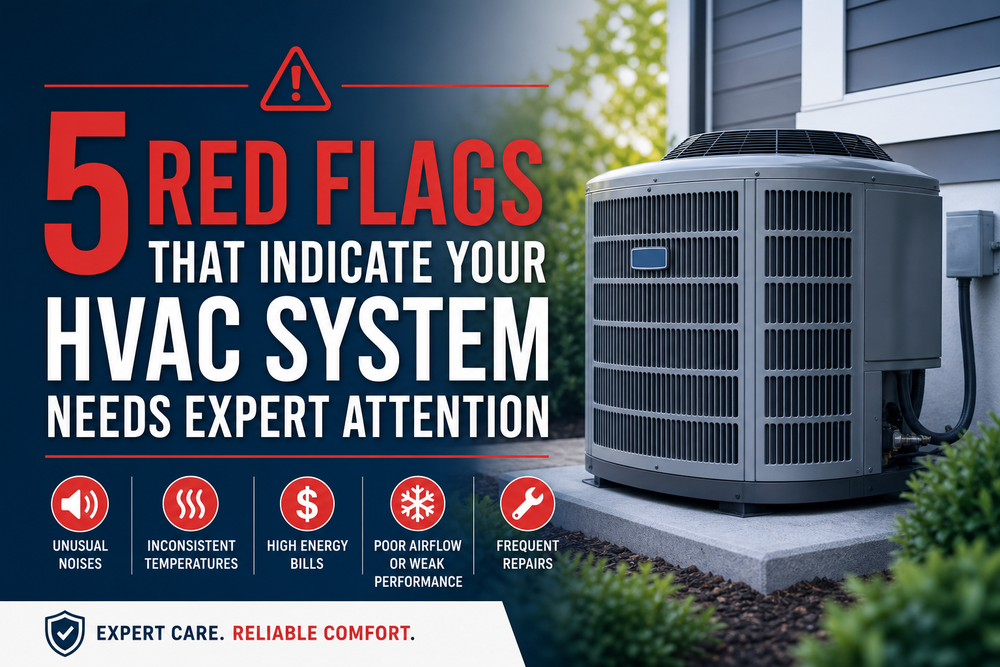
5 Red Flags Your HVAC System Needs Expert Attention
5 Red Flags Your HVAC System Needs Expert Attention
HVAC making strange noise, weak airflow from vents, high energy bill HVAC, HVAC short cycling causes, burning smell from HVAC, when to replace HVAC system, HVAC inspection cost, signs HVAC needs repair
5 Red Flags That Indicate Your HVAC System Needs Expert Attention
Your HVAC system works silently every day to keep your home comfortable — but when something goes wrong,
ignoring the warning signs can lead to costly repairs or even full system replacement.
Most homeowners only call a technician after a complete breakdown, but the truth is that HVAC problems
almost always show warning signs weeks or even months before they become emergencies. Knowing how to
spot those early red flags can save you thousands of dollars and a lot of discomfort.
In this article, we cover the five most common signs that your HVAC system needs expert attention —
what causes them, what happens if you ignore them, and what a certified technician will typically do to fix them.
1. Unusual Noises Coming From the Unit
A well-functioning HVAC system should run with a consistent, low hum. If you start noticing sounds that
weren’t there before, that’s your system telling you something is mechanically wrong. Different
sounds point to different problems, so it’s worth paying attention to exactly what you’re hearing.
- Banging or clanking usually means a loose or broken part — such as a connecting rod, piston pin, or crankshaft — is moving around inside the compressor. Left untreated, this can destroy the compressor entirely, which is one of the most expensive parts to replace.
- Squealing or screeching often points to a worn fan belt or motor bearing that needs lubrication or replacement. This is a relatively inexpensive fix when caught early.
- Rattling can indicate loose panels, debris caught in the unit, or early-stage motor failure. Sometimes it’s as simple as tightening a screw — but it can also signal a failing motor.
- Grinding is a serious sign. It typically means motor bearings are worn out and the motor is under severe strain. Continuing to run the system in this state can burn out the motor completely.
- Clicking that won’t stop during startup or shutdown can point to a failing relay or electrical control issue, which can create safety hazards if ignored.
As a rule: one-time sounds are usually nothing. Persistent or recurring noises always warrant a professional inspection.
2. Weak or Inconsistent Airflow
If you notice that some rooms feel much warmer or cooler than others, or if the air coming out of your vents
feels weak even when the system is running at full capacity, you’re dealing with an airflow problem.
Poor airflow is one of the most common HVAC complaints — and one of the most misunderstood,
because it can have several very different causes.
- Clogged air filter is the most frequent culprit. A dirty filter restricts airflow severely, forces the system to work harder, and can cause the evaporator coil to freeze. Filters should be replaced every 1–3 months depending on usage and household conditions.
- Blocked or leaking ducts can reduce airflow to specific rooms. Ducts can develop leaks over time due to age, pests, or poor installation — and up to 30% of conditioned air can be lost through duct leaks according to the U.S. Department of Energy.
- Failing blower motor is responsible for pushing air through the ductwork. When it starts to fail, the entire system loses pressure and airflow drops throughout the house.
- Frozen evaporator coil blocks airflow almost completely. This often happens as a result of another problem — like a dirty filter or low refrigerant — and needs immediate attention to prevent compressor damage.
- Undersized system — if the unit was never properly sized for your home, it will struggle to maintain even temperatures, particularly in larger rooms or during extreme weather.
If changing the filter doesn’t solve the problem within a day or two, it’s time to call a technician to
inspect the ducts, coils, and blower.
3. Unusual Spikes in Energy Bills
Your energy bill is one of the most reliable indicators of HVAC health. A sudden and unexplained increase —
especially when your usage habits haven’t changed — almost always means the system is consuming
more energy than it should to maintain the same output. This is called reduced efficiency, and it
compounds over time: the longer you wait, the more you pay each month.
- Refrigerant leak forces the compressor to run longer cycles to try to reach the target temperature, consuming significantly more electricity. Low refrigerant also damages the compressor over time.
- Dirty condenser or evaporator coils reduce heat transfer efficiency. The system has to run harder and longer to compensate, driving up energy costs by 20–40% in severe cases.
- Aging equipment loses efficiency naturally over time. A 15-year-old system running at 60% efficiency can cost twice as much to operate as a modern high-efficiency unit — even if it hasn’t broken down yet.
- Thermostat problems — a malfunctioning thermostat may read temperatures incorrectly, causing the system to run when it doesn’t need to or fail to shut off at the right time.
- Duct leaks also drive up energy bills because conditioned air escapes into unconditioned spaces like attics or crawlspaces, forcing the system to produce more to make up the difference.
A good benchmark: if your energy bill is more than 15–20% higher than the same month last
year without a clear explanation, have your HVAC system inspected.
4. Frequent Cycling On and Off
HVAC systems go through natural on/off cycles to maintain your set temperature — typically 2–3 cycles per
hour under normal conditions. Short cycling is when the system turns on and off much more
frequently, sometimes every few minutes, without completing a full cycle. This behavior puts extreme wear
on the equipment and dramatically shortens its lifespan.
- Oversized system is one of the most common causes. A unit that’s too large for the space cools or heats it too quickly, shuts off before completing a full cycle, then turns back on shortly after. This is called “oversizing” and it’s a design flaw that requires either equipment replacement or zoning adjustments.
- Refrigerant leak causes the system to lose its ability to maintain temperature, triggering repeated restart attempts as it struggles to reach the setpoint.
- Faulty thermostat — a thermostat placed near a heat source, in direct sunlight, or simply malfunctioning can send incorrect readings that cause the system to cycle erratically.
- Dirty air filter or frozen coil can trigger the system’s safety shutoff repeatedly, creating the appearance of short cycling when it’s actually a protective response.
- Electrical issues — failing capacitors or contactors can cause the compressor to trip its own safety switches and restart in rapid succession.
Short cycling is particularly damaging because startup is the most stressful moment for HVAC
components. Excessive startups accelerate compressor wear and can lead to complete failure
within months if the root cause isn’t addressed.
5. Bad Odors When the System Is Running
Strange smells coming from your vents are never normal and should never be ignored. Different odors
indicate very different problems — some are health hazards, others are safety emergencies that
require you to shut the system off immediately.
- Musty or moldy smell is the most common odor complaint. It typically means mold or mildew has grown inside the ductwork, on the evaporator coil, or in the drain pan. This is a serious indoor air quality issue — mold spores circulate through your home every time the system runs and can trigger respiratory problems, allergies, and asthma.
- Burning or electrical smell can indicate overheating motor windings, a failing capacitor, or burning dust on the heat exchanger during first use of the season. If the smell is persistent or strong, turn the system off immediately and call a technician — electrical fires in HVAC equipment are a real risk.
- Rotten egg or sulfur smell is a potential gas leak signal if you have a gas furnace. This is an emergency. Leave the building immediately, avoid using any electrical switches, and call your gas company and emergency services.
- Chemical or sweet smell can indicate a refrigerant leak. Refrigerant exposure is harmful to health and the environment, and a leaking system also loses efficiency rapidly.
- Dirty sock smell — a surprisingly common complaint, caused by bacteria growth on a wet evaporator coil. It needs professional coil cleaning and possibly UV light treatment to prevent recurrence.
As a general rule: any persistent odor that appears when the HVAC runs requires professional
inspection. Do not mask the smell with air fresheners and hope it goes away.
Why Acting Fast Saves Money
HVAC problems follow a pattern: a small issue creates stress on surrounding components, which then develop
their own problems, until what started as a $200 repair becomes a $3,000 system replacement. Early
intervention by a certified technician can:
- Prevent complete system failure and avoid expensive emergency replacements at the worst possible time
- Improve energy efficiency and bring your monthly utility costs back to normal
- Extend the lifespan of your heating and cooling equipment — a well-maintained system can last 15–20 years
- Protect indoor air quality and the respiratory health of everyone in your household
- Maintain your manufacturer’s warranty, which often requires documented professional service at regular intervals
- Avoid emergency service fees — technicians charge premium rates for after-hours and weekend calls that a scheduled visit would have prevented
How Often Should You Schedule HVAC Maintenance?
Most HVAC manufacturers and certified technicians recommend professional service twice a year:
once in spring before cooling season, and once in fall before heating season. During these visits, a technician
will clean coils, check refrigerant levels, test electrical components, lubricate moving parts, and inspect
the ductwork — catching small problems before they become costly failures.
If you recognize any of the five red flags described in this article, don’t wait for a complete
breakdown. Schedule a professional HVAC inspection today and keep your system running safely and
efficiently year-round.
Leave a Reply